
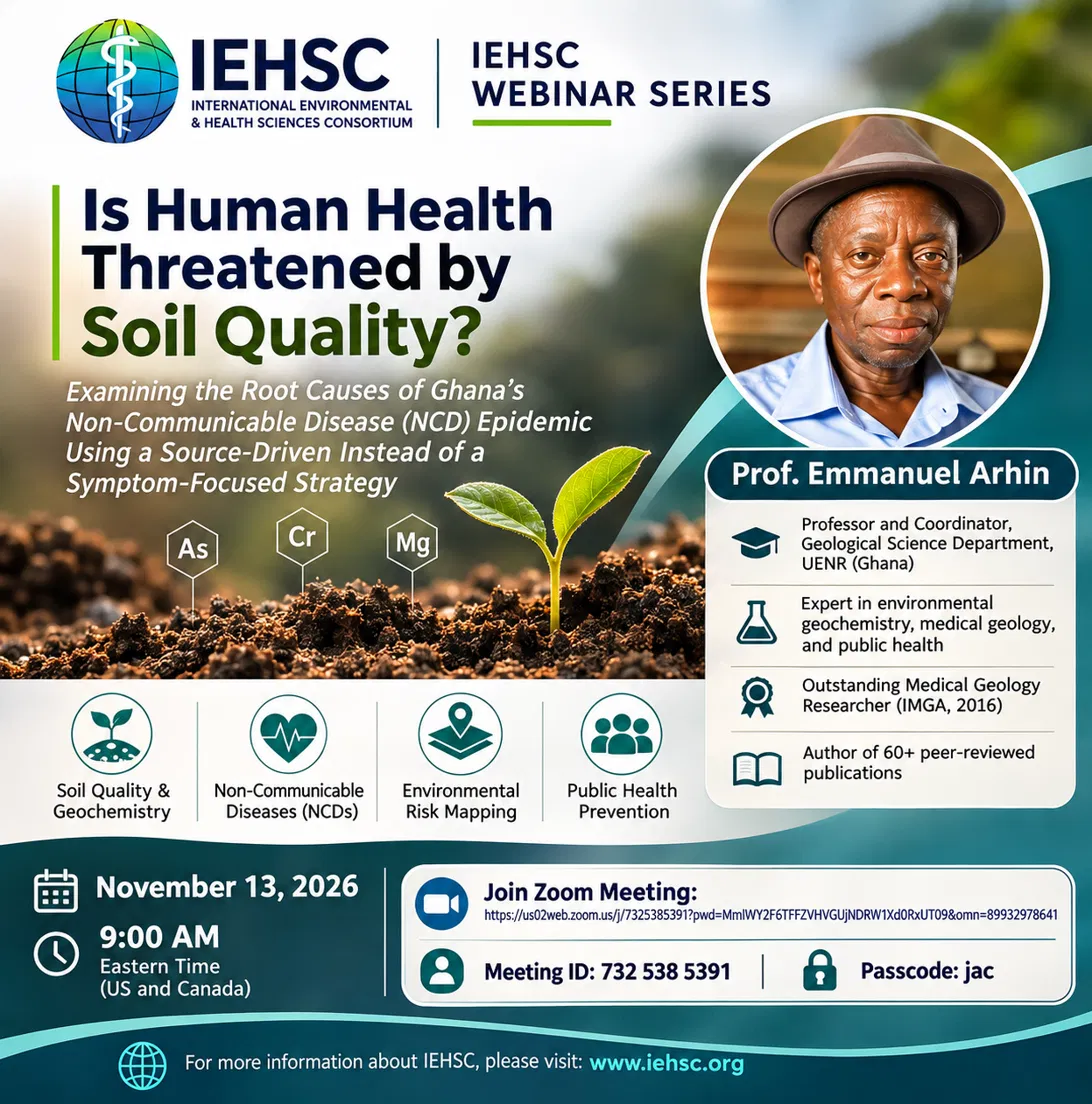
Is Human Health Threatened by Soil Quality?
Examining the root causes of Ghana’s non-communicable disease (NCD) epidemic using a source-driven instead of a symptom-focused strategy.

Event details
About the webinar
Conventional healthcare focuses on the symptoms of disease. This webinar takes an environmental standpoint instead, treating the Earth itself as the patient. Non-communicable diseases (NCDs) are usually blamed on lifestyle choices, yet environmental triggers in soil and water often act as unseen contributors.
Drawing on medical geology studies in the Wassa area of Southwest Ghana, Prof. Arhin will show how spatial mapping revealed a consistent link between NCD occurrence and geographic zones with high levels of toxic metals and shortages of essential elements, and how element geoavailability maps can help public health officials anticipate NCD trends before clinical symptoms appear.
Findings from the Wassa area, Southwest Ghana. In communities such as Akropong and Bogoso, high arsenic concentrations were associated with hypertension, diabetes and several cardiovascular conditions.
From symptoms to source
- Treats disease once clinical signs appear
- Labels NCDs simply as “lifestyle diseases”
- Relies on reactive medical treatment
- Traces disease back to the geochemistry of soil and water
- Maps hotspots and coldspots of toxic and essential elements
- Enables preventive interventions at the environmental source
Key topics
Soil quality & geochemistry
How toxic metals and essential-element deficiencies in soil shape community health.
Non-communicable diseases
Why hypertension, diabetes, and heart and kidney diseases may have geological roots.
Environmental risk mapping
Using element geoavailability maps to forecast disease hotspots before symptoms appear.
Public health prevention
Why earth scientists and medical professionals must work together to reduce hidden environmental risks.
Prof. Emmanuel Arhin
Professor and Coordinator, Geological Science Department, School of Geosciences, University of Energy and Natural Resources (UENR), Ghana
Prof. Emmanuel Arhin is a geoscientist whose work connects the earth sciences with environmental health. A leading expert in medical geology, he studies how geological processes, soil contamination and trace-element geochemistry affect public health. A major focus of his current work is identifying NCD hotspots in Ghana linked to environmental exposure. He is also a Professional Geoscientist and CEO of EarthPro Consultancy Group, and has served as Dean of the School of Geosciences at UENR and Head of the Earth Science Department at the University for Development Studies.
In mineral exploration, he is known for innovative geochemical approaches in regolith-dominated terrains, including biogeochemical methods such as termite mound and back-of-tree sampling to detect hidden gold anomalies. He has worked with Newmont and Ashanti Exploration (a subsidiary of AngloGold Ashanti) and serves as a Technical Advisor to international mineral and mining companies.
Education
PhD in Geology, University of Leicester (UK)
MPhil in Mineral Exploration, KNUST (Ghana)
BSc in Geological Engineering
Leadership
Global Councillor, International Medical Geology Association (IMGA)
Board Member, Society for Environmental Geochemistry and Health (SEGH)
Fellow, Society of Economic Geologists (SEG)
Recognition
Outstanding Medical Geology Researcher, IMGA (2016)
Publications
60+ peer-reviewed journal articles, special publications and conference proceedings on GeoHealth and mineral exploration
Related reading
Learn more about the element geoavailability maps behind this research: Linking geology to the prevalence of non-communicable diseases.
Keywords
Join us on November 13
Please share this invitation with colleagues and students who may be interested. We look forward to seeing you there!